
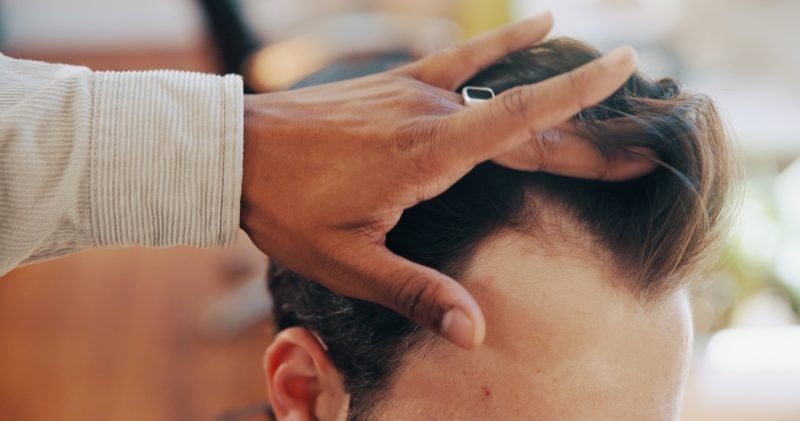
Catching the earliest signs of male pattern baldness gives you a chance to address hair loss before it becomes more noticeable. Depending on the individual and the treatment, early intervention may help slow or stabilize hair loss and, in some cases, partially restore hair density.
Male pattern baldness, medically known as androgenetic alopecia, can develop at almost any age. While it becomes increasingly common with age, hair loss can begin in the late teens or 20s, meaning you don’t necessarily have to wait until your 30s or 40s to notice the first signs.
Because the changes can be gradual, early hair loss isn’t always obvious. Knowing what to look for can help you recognize changes in your hairline, density, texture, and overall coverage.
What Causes Male Pattern Baldness?
Male pattern baldness, medically called androgenetic alopecia, occurs when genetically susceptible hair follicles become progressively more sensitive to a hormone called dihydrotestosterone (DHT).
Here’s the basic process:
- Testosterone is converted to DHT. An enzyme called 5-alpha-reductase converts some testosterone into DHT.
- DHT interacts with susceptible follicles. In people genetically predisposed to male pattern baldness, certain follicles, particularly around the hairline, temples, and crown, are more sensitive to DHT.
- The follicles gradually miniaturize. DHT can cause susceptible follicles to produce progressively thinner, shorter hairs. This process is called follicular miniaturization.
- The growth cycle changes. The active growth phase becomes shorter, while the resting phase can become relatively longer. Over successive cycles, the resulting hairs become finer and less noticeable.
- Eventually, some follicles produce only very fine hairs. Eventually, follicles may produce only fine, barely visible hairs, but early treatment may help preserve or improve hair density.
Why Does It Affect Some Men But Not Others?
Ultimately, genetics plays a major role in male pattern baldness. Your genes influence how your hair follicles respond to androgens, including DHT. Male pattern baldness can be inherited from either side of the family, not just your mother’s or father’s side.
Importantly, male pattern baldness isn’t simply a matter of having “too much” testosterone or DHT. Two men can have similar hormone levels but experience different degrees of hair loss because their follicles can be more or less sensitive to androgen signaling.
The pattern of hair loss can also vary. Some men primarily experience recession at the temples and frontal hairline, while others notice more prominent thinning at the crown or across the top of the scalp.
Signs of Male Pattern Baldness
Male pattern baldness typically develops gradually. One of the first noticeable signs may be recession at the hairline or thinning on the top of the head.
Common early signs include:
- Thinning temples: The hair around the temples may gradually thin or begin to recede.
- A receding hairline: The frontal hairline may gradually move backward, sometimes creating a more pronounced M-shaped pattern.
- Thinning at the crown: You may notice more scalp visibility around the crown or vertex, especially under bright light or when your hair is wet.
However, some of the earliest changes can be much more subtle.
Less Obvious Early Signs of Male Pattern Baldness
- Changes in hair texture: Hair may gradually become finer, softer, or less substantial as individual follicles begin to miniaturize.
- Gradual thinning: Individual strands may become thinner than before, even before you notice obvious areas of baldness.
- Less volume: Your usual hairstyle may no longer look as full or hold its shape as easily.
- Slower apparent hair growth: Hair may seem to take longer to reach the length or fullness you are used to.
- A changing hairline: The temples may gradually recede, or the frontal hairline may become less dense before significant recession becomes obvious.
- More visible scalp: As hair density decreases, more scalp may show, especially under bright light or when your hair is wet.
- Increased shedding: You may notice more hair in the shower, on your pillow, or in your brush. However, shedding alone does not necessarily mean you have male pattern baldness. Normal daily shedding occurs as part of the hair-growth cycle, and increased shedding can have many different causes.
The key is to look for progressive changes in density, hairline position, and hair thickness, rather than focusing solely on how much hair you see in the shower.
How to Assess Your Level of Hair Loss With the Norwood Scale
The Norwood-Hamilton Scale, commonly called the Norwood Scale, is a widely used classification system for describing the progression and severity of male pattern hair loss. It categorizes hair loss from Stage 1 through Stage 7.
- Stage 1: Little to no significant hair loss or recession. The hairline retains a youthful appearance.
- Stage 2: Mild temple recession, sometimes resembling a normal “mature” hairline.
- Stage 3: More pronounced temple recession, creating an M-, U-, or V-shaped hairline.
- Stage 3 Vertex: The hairline remains relatively stable, but noticeable thinning develops at the crown.
- Stage 4: Further hairline recession with noticeable crown loss. A band of hair remains between the two areas.
- Stage 5: Front and crown hair loss becomes more extensive, and the separating band thins.
- Stage 6: The band disappears, connecting the frontal and crown areas into one larger area of hair loss.
- Stage 7: The most advanced stage, with hair remaining mainly around the sides and back in a horseshoe pattern.

The Norwood Scale can describe the pattern and extent of hair loss, but it doesn’t determine the cause of every individual’s thinning. A dermatologist can evaluate your scalp and hair to determine whether the changes match male pattern baldness or another form of hair loss.
Can Male Pattern Baldness Be Reversed?
Male pattern baldness can sometimes be slowed, stabilized, and partially reversed, particularly when treatment begins early.
Treatment often aims to preserve the hair you still have while potentially improving the thickness and density of miniaturized hairs. Treatments such as minoxidil and finasteride can reduce further hair loss, and some men experience hair regrowth. The American Academy of Dermatology notes that men generally see better results when they start treatment soon after noticing hair loss.
