Does Hair Loss From Traction Alopecia Grow Back?
Have you noticed your hairline moving back further? You don’t have to feel insecure about your hairline, and you’re not alone. Traction alopecia is common, especially among people who frequently
At Natural Transplants®, we offer specialized hair transplant solutions tailored for women experiencing hair loss from all types of conditions, including genetic hair loss (Androgenic Alopecia) and Traction Alopecia. Many women, like men, experience hair loss at some point in their lives. Often, hair loss in women is due to genetic factors. However, some women experience hair loss due to destructive hair styles and patterns which permanently damage hair. In fact, our clinic serves an abundance of female patients. Natural Transplants is one of the few clinics world-wide that specializes in female hair transplants and treating African American female hair loss. Get started now with restoration options for women.
Mateyena
Actual Natural Transplants Patient
Unlike men, women are more likely to experience thinning hair or loss of frontal edges rather than balding. It is important to know that women can experience hair loss from various causes. These include medical (i.e., thyroid), hormonal, pregnancy, perms (chemical), braids (traction alopecia), female pattern baldness, and many others.
When exploring hair loss treatment options and setting expectations for hair growth after a hair transplant, it’s important to identify the specific type of hair loss you’re experiencing. Depending on the cause, there may be both nonsurgical and surgical options available to you.
It only takes a day to get your hair back. Schedule your free, no-obligation consultation with a licensed doctor from Natural Transplants.
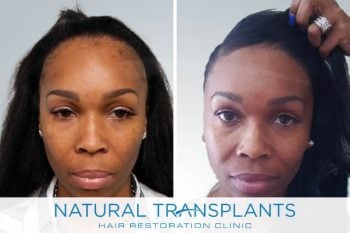
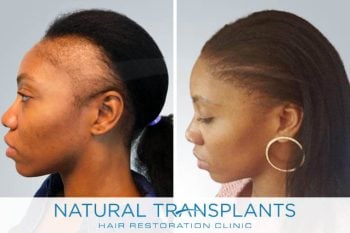
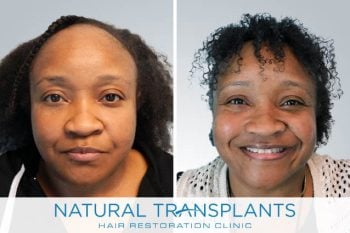
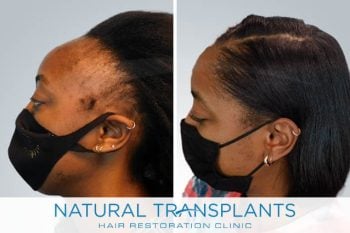
View the transformative results achieved by women through hair transplants. Individual results may vary.
Simply put, a female hair transplant is a procedure that relocates permanent hair from one area to another that lacks coverage, such as the hairline or the top of the head. The two primary techniques used are FUE and FUT (our HUE or HUE+ method, an advanced version of the FUT technique).
The ideal female hair transplant candidate has limited hair loss, is not expected to experience significant future hair loss, and possesses healthy donor hair.
It’s important to recognize that hair transplants do not prevent future hair loss in women, especially if you return to the destructive hair styles and patterns that caused the loss of hair in the first place. Rather, they are performed to restore lost hair, often replacing less than the total amount lost. Bearing this in mind, our doctors at Natural Transplants offer realistic goals and expectations to women considering a hair transplant procedure.
See real results from female hair transplant patients. Individual results may vary.
Female hair loss can be caused by a variety of factors, including genetics (female pattern hair loss), hormonal changes (e.g., menopause, pregnancy), medical conditions (thyroid disorders, autoimmune diseases), medications, stress, or nutritional deficiencies. A particularly common cause is traction alopecia, which is hair loss caused by chronic pulling tension from damaging hairstyles like tightly pulled braids, ponytails, weaves, or extensions.
No, female hair loss usually presents as overall thinning rather than a receding hairline. The Ludwig Scale is used to classify female hair loss.
Common signs include diffuse thinning across the scalp, widening of the part, excessive shedding, or hair that feels weaker or breaks easily.
In many cases, female hair loss can be slowed, managed, or partially reversed depending on the cause. Treatments such as topical minoxidil, hormone therapy, advanced biologics like exosomes, or addressing underlying medical or nutritional issues can help restore hair growth and improve density, especially when started early.
Yes, the results from a hair transplant are generally permanent for women. The transplanted hair follicles are typically harvested from areas resistant to the hormones that cause thinning, so they should continue to grow for a lifetime.
However, to protect the transplanted hair and prevent loss in the surrounding natural hair, patients must avoid damaging hairstyles and products that cause tension or trauma to the scalp. Damaging styles like tight braids, ponytails, or extensions can lead to a condition called traction alopecia, which can destroy the transplanted follicles and surrounding hair. Ongoing maintenance or preventative treatments may also be recommended to manage progressive thinning in the non-transplanted areas.
Recovery from a hair transplant for women typically follows a similar timeline as for men. Most patients can resume normal, non-strenuous activities within a few days, while full healing of the donor and grafted areas usually takes 2–3 weeks.
Regarding hair growth, while some patients may notice initial activity, hair starts to grow visibly around 3–4 months post-surgery, and most patients begin to see significant, noticeable growth six to nine months after the procedure. You can expect to see the full, final density of the results achieved around the 12-month mark, though some individuals may require additional months to see complete maturity.
The hair transplant procedure itself is performed under local anesthesia, which ensures that pain during the extraction and implantation process is minimal.
However, the initial local anesthesia injections into the scalp are typically reported as the most painful part of the entire process, often described as a brief, intense stinging or pinprick sensation that quickly fades as the numbing agent takes effect.
Once the scalp is numb, you will feel pressure, but not sharp pain. Mild soreness in the treated areas may last for a few days following the surgery and is usually managed with prescribed pain medication.
Both FUE and FUT leave some scarring, but it’s usually minimal and easy to conceal. FUE transplants leave tiny dot-like scars that are barely noticeable, while FUT leaves a thin linear scar, which can be hidden under longer hair. At Natural Transplants, our hair transplant surgeons are skilled, making sure both methods leave behind minimal.
Hair growth is a gradual process. While some initial activity may occur, hair starts to grow visibly around 3–4 months post-surgery, and most patients begin to see significant, noticeable growth six to nine months after the procedure. Your 12-month follow-up appointment is typically around the time many patients see their final results, though some individuals may require additional months for the hair to reach its full, final density and maturity.
Women with sufficient donor hair and localized thinning may greatly benefit from a hair transplant. Good candidates are typically those who have achieved hormonal stability, have realistic expectations about the outcome, and are committed to avoiding damaging hairstyles (such as tight braids, ponytails, or extensions) and products that can cause traction alopecia, which can damage the transplanted follicles.
During your initial consultation, a hair restoration specialist at Natural Transplants will provide a thorough scalp and donor assessment to determine whether a hair transplant is the most suitable solution for your specific pattern of hair loss.
Is a hair transplant right for you? Get an initial, no-obligation assessment from our staff. It takes 30 minutes or less, and can be done virtually.
Take control of your hair journey. Our customized hair transplant solutions empower women of all hair types.
Exosome therapy can work to regenerate hair follicles, improve hair density and support scalp health in women.
Our clinic offers scar revision to minimize visible scars from hair transplants and other scalp procedures.

Have you noticed your hairline moving back further? You don’t have to feel insecure about your hairline, and you’re not alone. Traction alopecia is common, especially among people who frequently

Have you looked in the mirror or at a recent photo and noticed that one side of your hairline appears higher than the other? You may be asking yourself, “why

My Hair Is Falling Out After Dying It. Will It Grow Back? Many people use hair dye to cover gray hair, look younger, or even to express themselves with fun

Lush, healthy hair is often associated with beauty and femininity. For many women, hair is a part of their identity and self-expression. Because of this, hair thinning can take a
At Natural Transplants, our honest and experienced hair transplant surgeons are available to assess your hair loss and determine the most suitable hair restoration options for you. See why thousands of women have chosen Natural Transplants for their hair transformation.
Actual Natural Transplants Patient